


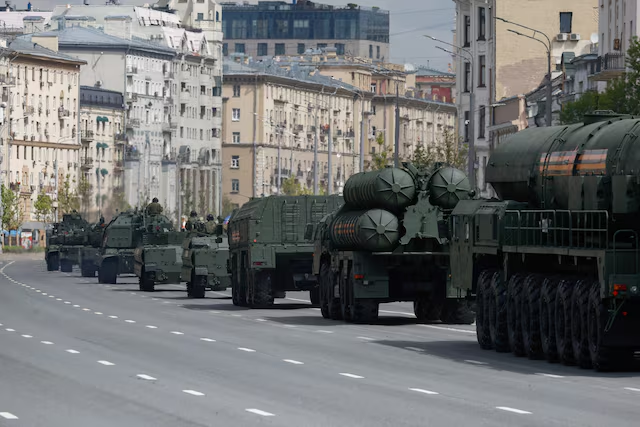
Diplomatic Tensions Escalate as Chinese President Arrives Amid Security Concerns
Ukrainian drones have targeted Moscow for a third consecutive day, forcing the closure of most of the Russian capital’s airports just hours before Chinese President Xi Jinping’s scheduled arrival for a high-profile visit intended to showcase support for President Vladimir Putin. The timing of these attacks carries significant diplomatic implications as Russia prepares to commemorate the 80th anniversary of the Soviet victory over Nazi Germany.
Strategic Timing of Ukrainian Strikes
The Ukrainian drone offensive represents a calculated attempt to disrupt a major diplomatic event that holds immense symbolic importance for Moscow. By targeting the Russian capital ahead of Xi Jinping’s arrival, Ukraine appears to be sending a clear message regarding its opposition to international support for Russia during the ongoing conflict.
“The timing of these drone strikes is no coincidence,” said Dr. Elena Korosteleva, professor of International Relations at a leading European university. “This is Ukraine’s way of asserting its presence on the international stage at a moment when Russia is attempting to demonstrate that it remains a respected global power despite Western sanctions.”
The drone attacks have not only disrupted air travel but have also forced Russian authorities to enhance security measures throughout the capital, potentially complicating the logistics of Xi’s visit and the upcoming military parade.
Xi’s Visit: Economic Lifeline and Diplomatic Support
President Xi’s visit to Moscow carries particular weight at this juncture in the Russia-Ukraine conflict. China has become Russia’s largest trading partner and a crucial economic ally, helping Moscow navigate Western sanctions through increased energy purchases and financial cooperation.
“China has thrown Moscow an economic lifeline,” noted Alexander Gabuev, a senior fellow at the Carnegie Russia Eurasia Center. “Xi’s presence at the Victory Day celebrations sends a powerful message that Russia is not isolated on the world stage, despite Western attempts to make it a pariah state.”
The Chinese president is the most prominent world leader expected to attend Friday’s military parade on Red Square, where Chinese troops are scheduled to march alongside Russian forces. This symbolic display of military solidarity comes despite Ukraine’s Foreign Ministry urging countries to refrain from sending their militaries to participate in the parade, arguing that such participation contradicts declared neutrality in the conflict.
Chinese Diplomatic Balancing Act
Beijing continues to perform a delicate balancing act regarding the Russia-Ukraine conflict. When questioned about the air attacks on both capitals, a Chinese foreign ministry spokesperson avoided commenting directly on Xi’s trip, emphasizing only that the “top priority” was avoiding an escalation in tensions.
In a signed article published by Russian media on Wednesday, Xi wrote that China and Russia must “firmly maintain the post-war international order” and “jointly resist any attempt to disrupt and undermine China-Russia friendship and mutual trust.”
Yun Sun, a China politics analyst at the Stimson Center in Washington, explained the significance of this rhetoric: “The World War Two focus is about the post-war international order and now the U.S. is dismantling or undermining it. So China and Russia will frame themselves as the defenders of the international order and the UN system, and oppose U.S. unilateralism and hegemony.”
This positioning aligns with both countries’ strategic interests in promoting a multipolar world order that challenges what they perceive as American dominance.
Trump’s Peace Efforts Complicated
Xi’s high-profile visit to Moscow comes as U.S. President Donald Trump attempts to push both Russia and Ukraine toward a negotiated settlement. The Chinese leader has previously called for talks to end the war while simultaneously criticizing American weapons supplies to Kyiv.
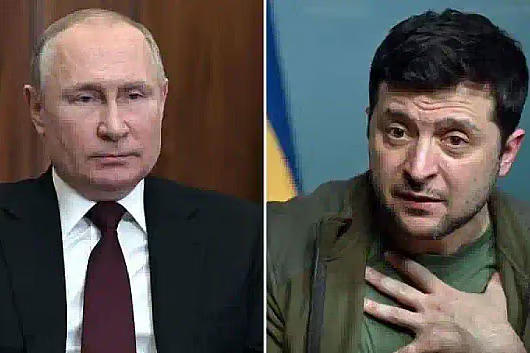
Ukrainian President Volodymyr Zelenskyy has urged Xi to use his influence to persuade Putin to end the conflict, but many analysts remain skeptical about China’s willingness to pressure its strategic partner.
“Xi’s visit effectively complicates Trump’s peace efforts by signaling unwavering Chinese support for Russia at this critical juncture,” said Dr. Sarah Paine, a professor of strategy and policy. “This reinforces Putin’s confidence that he can continue the conflict without facing total international isolation.”
Mutual Attacks on Capitals
While Ukrainian drones targeted Moscow, Russian forces launched their own air attack on Kyiv overnight, reportedly killing a mother and her son. These parallel strikes on both capitals highlight the increasingly direct nature of the conflict, with both sides willing to target each other’s centers of power.
The Kremlin characterized the Ukrainian drone attacks as evidence of Kyiv’s tendency to commit “acts of terrorism” and assured that Russian intelligence services and military were taking all necessary measures to ensure security for the upcoming anniversary commemorations.
Economic Cooperation on the Agenda
Beyond the symbolic aspects of Xi’s visit, substantive discussions are expected between the Chinese leader and President Putin. According to Kremlin aide Yuri Ushakov, their talks will address “the most sensitive” issues, including energy cooperation and the proposed but not yet constructed Power of Siberia 2 gas pipeline to China.
This massive infrastructure project would further cement the energy partnership between the two countries, providing Russia with a stable market for its natural resources in the face of reduced European demand due to sanctions.
Global Implications
The deepening Russia-China partnership, symbolized by Xi’s attendance at the Victory Day parade, represents a significant challenge to Western efforts to isolate Russia economically and diplomatically. It also highlights the emerging multipolar dynamics in global politics, with China and Russia increasingly coordinating their positions in opposition to what they perceive as Western hegemony.
“We’re witnessing the solidification of a strategic partnership that could reshape global power dynamics for decades to come,” observed Professor Alexander Cooley, an expert on Eurasian politics. “Xi’s visit to Moscow during such a sensitive period in the Russia-Ukraine conflict demonstrates Beijing’s willingness to weather Western criticism in pursuit of its strategic interests.”
As Chinese and Russian troops prepare to march together on Red Square, the world watches closely to see how this display of unity might influence the trajectory of the conflict in Ukraine and broader international relations in an increasingly divided global landscape.
What to Watch
The outcomes of Thursday’s talks between Xi and Putin will be closely scrutinized for:
- New energy agreements, particularly regarding the Power of Siberia 2 pipeline
- Joint statements on the Ukraine conflict and potential peace initiatives
- Coordinated positions on challenging Western sanctions
- Military cooperation announcements
- Trade agreements that could further integrate the Russian and Chinese economies
As Ukrainian drones and Russian air defenses continue their deadly dance over Moscow, the pageantry of Xi’s visit underscores the complex interplay of military action, diplomatic maneuvering, and strategic realignment that characterizes this phase of the Russia-Ukraine conflict.



Leave a comment