


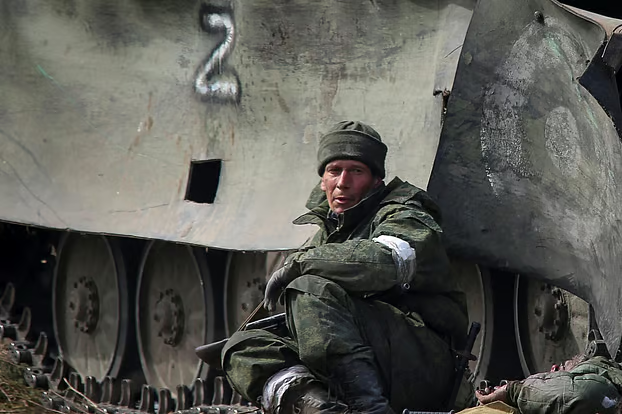
Pro-Russian member beside a soldier killed during clashes in Mariupol, March 31, 2022. Photo: Reuters
Last year was the deadliest period for Russian forces since the full-scale war between Russia and Ukraine began. At least 45,287 soldiers were killed this year.
This death toll is nearly three times higher than the first year of the war and much higher than the casualties in 2023. The longest and deadliest battle of this war took place in Bakhmut in 2023.
At the beginning of the war, Russia suffered massive casualties in battles to capture strategically important areas step by step. However, in 2024, as the front line advanced slowly, the number of deaths increased month by month. And this has helped the BBC establish a calculation of 27 deaths per kilometer in Ukraine. [This calculation was based on an estimated 112,000 deaths last year]
With the help of independent media outlet Mediazona and a team of volunteers, BBC Russian Service analyzed data from open sources on Russian cemeteries, memorials, and obituaries.
So far, the BBC has identified 106,745 Russian soldiers killed in Russia’s full-scale campaign in Ukraine.
However, the actual number of deaths is clearly much higher. Military experts estimate that the number of casualties the BBC found represents only 45 to 65 percent of the total deaths. This means the actual death toll could be between 164,223 and 237,211.
February 20, 2024, was the most devastating day of the year for Russian forces.
On that day, near the captured city of Volnovakha in Donetsk, many soldiers, including Aldar Bayrov, Igor Babich, and Okhunjon Rustamov of the 36th Motorized Rifle Brigade, were killed in a Ukrainian long-range HIMARS (High Mobility Artillery Rocket System) missile attack on a training ground.
They had been lined up for a medal ceremony. In this attack, 65 soldiers, including Commander Colonel Musayev, were killed and many more were wounded.
Bayrov, 22, from the eastern Siberian region of Buryatia, was studying to become a food quality and hygiene specialist. But after being called up for mandatory military service, he signed a contract as a professional soldier.
He went to Ukraine to fight in February 2022. He participated in the battle of Borodianka in March of that year when Russian troops were advancing toward Kyiv. The city was almost completely destroyed in the fighting. Ukrainian sources have claimed that Russian soldiers were involved in the killing of civilians during this time.
Okhunjon Rustamov, 31, from the Siberian city of Chita, worked as a welder after completing his mandatory service in the special forces. He was called up to the military during Russia’s partial mobilization in October 2022.
Igor Babich, 32, however, volunteered for the war. Until April 2023, he had provided physiotherapy to adults and children suffering from cerebral palsy (a complex neurological disease).
According to data collected by the BBC, a total of 201 Russian soldiers lost their lives that day.
A few hours after the attack on the training ground, Russia’s then-Defense Minister Sergei Shoigu met with Vladimir Putin to report military successes on the battlefield.
But there was no mention of the attack on the training ground. There wasn’t a single word about it even in the Defense Ministry’s daily report.
A relative of Okhunjon Rustamov reported that he had already lost three close family members during the war. She said, “My husband died in December 2022. My godfather died on February 10, and my stepbrother was killed on February 20. One funeral after another.”
In its analysis, the BBC gave the highest priority to the specific date of soldiers’ deaths. When that wasn’t available, they used the date of the funeral or the date when the death was reported.
In the first two years of the war, i.e., 2022 and 2023, Russian casualties fluctuated like waves. Sometimes many people would be killed in intense fighting, sometimes the situation would remain calm.
In 2023-24, thousands of volunteers contracted by the Ministry of Defense were sent to war with just 10 to 15 days of basic training. Military experts say such inadequate training has drastically reduced soldiers’ chances of survival.
For example, consider 2023. Most casualties occurred between January and March. During this time, Russian forces were trying to capture the cities of Vuhledar and Bakhmut in the Donetsk region.
According to BBC calculations, Russia lost at least 17,890 soldiers in the first year of the full-scale invasion. This calculation did not include casualties among Russia’s two proxy forces or irregular fighter groups in occupied eastern Ukraine.
In 2023, this number rose to 37,633.
In 2024, the number of casualties was never seen to decrease significantly. During this time, fierce attacks were launched toward Pokrovsk and Toretsk after the bloody battles of Avdiivka and Robotyne.
In August 2024, when Ukrainian forces launched a cross-border attack in the Kursk region, conscripted Russian soldiers were also killed there. Between August 6 and 13 alone, an estimated 1,226 Russian soldiers lost their lives.
However, according to top US military analyst Michael Kofman, the Russian army suffered the most casualties during its slow eastward progress from September to November 2024.
Michael Kofman explains, “During this time, there was an emphasis on continuous attacks with scattered groups of armored artillery attackers. As a result, the overall number of casualties increased even more compared to the newly occupied territory.”
After nearly two years of intense fighting, on October 1, 2024, Russian forces captured the military equipment base in Vuhledar, Donetsk.
The American Institute for the Study of War (ISW) estimates that from September to November 2024, Russian forces captured 2,356 square kilometers of Ukrainian territory.
Even then, Ukrainian forces had not collapsed at the front.
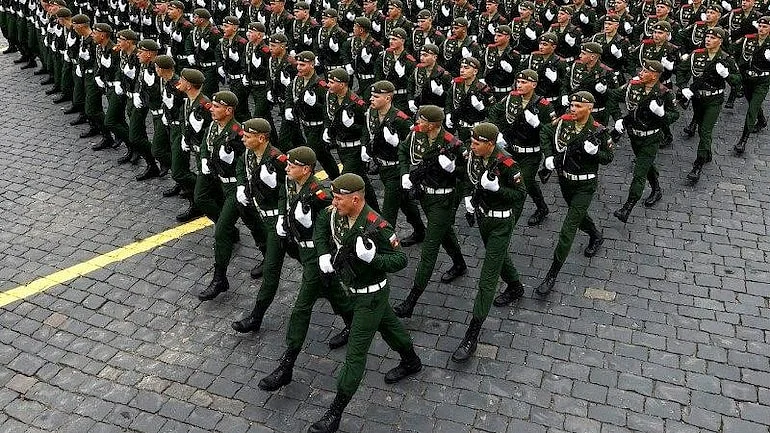
At least 11,678 Russian soldiers have been killed in this campaign. The actual number of casualties is feared to be even higher. The BBC has only counted those military members and officers whose names were in public obituaries and whose dates of death or funeral fell within this timeframe.
According to ISW data, Russia captured a total of 4,168 square kilometers of land in 2024. This means 27 Russian soldiers were killed for each square kilometer of captured territory. And this doesn’t even include the wounded.
How war casualties are affecting recruitment in the Russian army Russia has found various ways to increase its diminishing military strength.
Analyst Michael Kofman says, “In the second half of 2024, Russia increased military recruitment. The number of recruits exceeded the number of dead. As a result, Moscow got the opportunity to build new forces.”
The amount of one-time incentives for soldiers signing new recruitment contracts has been increased in three regions of Russia. In most areas, the war allowance volunteer soldiers receive is five to seven times higher than the local average income.
The BBC has also counted as “volunteers” those who enlisted in the armed forces to escape criminal cases under a law that came into effect in 2024.
The BBC’s calculations show that the number of volunteer soldiers among the dead is increasing at the fastest rate. One-fourth of the total identified dead soldiers so far were volunteer fighters.
In 2023-24, thousands of volunteers contracted by the Ministry of Defense were sent to war with just 10 to 15 days of basic training. Military experts say such inadequate training has drastically reduced soldiers’ chances of survival.
The Republic of Bashkortostan in Russia ranks at the top in terms of the number of casualties. So far, 4,836 deaths have been confirmed there. Most of the deceased were rural residents, 38 percent of whom went to war without any military experience.
In the Russian city of Ufa, the one-time incentive for signing a contract with the Russian army is 34 times the local average [monthly] salary of 67,575 rubles (£600).
Death counts collected from open sources will always be incomplete.
This is because the bodies of a large portion of soldiers killed in the last few months may still be on the battlefield. Recovering them is also risky for soldiers active in the field.
If the casualties of fighters from the self-proclaimed republics of Donetsk and Luhansk are taken into account, the true picture of Russian soldiers’ deaths would be even more devastating.
Analysis of obituaries and reports on the search for missing fighters shows that between 21,000 and 23,500 deaths are feared by September 2024.
Calculated this way, the total number of dead soldiers stands at between 185,000 and 260,700.


Leave a comment