


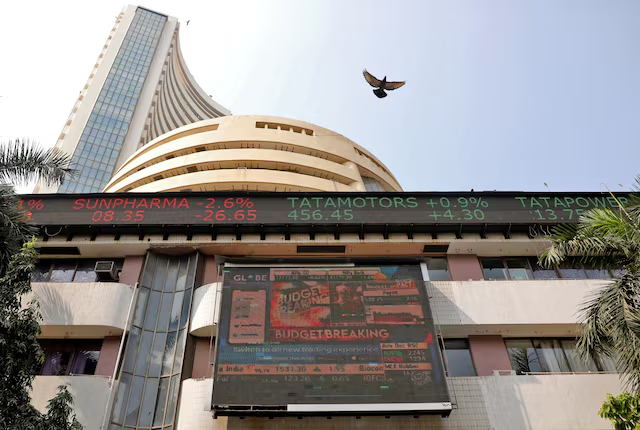
As military tensions escalate between India and Pakistan following India’s cross-border missile strikes, financial markets and investors are displaying remarkable resilience, with analysts suggesting that India’s economic trajectory is likely to remain largely unaffected barring a significant escalation of the conflict.
Markets Shrug Off Geopolitical Tensions
Despite the gravity of the military situation between the nuclear-armed neighbors, India’s $4 trillion economy has shown minimal immediate reaction to the hostilities. Local equity, currency, and bond markets demonstrated stability on Wednesday, reflecting investor confidence that a full-scale conflict remains unlikely.
“If there is a cessation of hostilities like there should be, pragmatically and practically, the investment climate may not actually be harmed,” said Ajay Marwaha, head of fixed income at Mumbai-headquartered investment house Nuvama Group.
This stability follows historical patterns. Citibank analysts highlighted in a Wednesday note that previous conflicts have not had lasting impacts on Indian assets:
- During the February 2019 flare-up with Pakistan, the Indian rupee remained steady and bond yields, after rising 15 basis points that month, eventually retreated.
- Similarly, during the June 2020 border clashes with Chinese troops in the Galwan valley, the rupee weakened only temporarily by 1% before regaining ground as tensions eased.
India’s Economic Fundamentals Remain Strong
India is projected to maintain its position as the world’s fastest-growing major economy, with the central bank forecasting GDP growth of 6.5% for the current financial year. This robust economic outlook continues to attract investor interest despite the regional tensions.
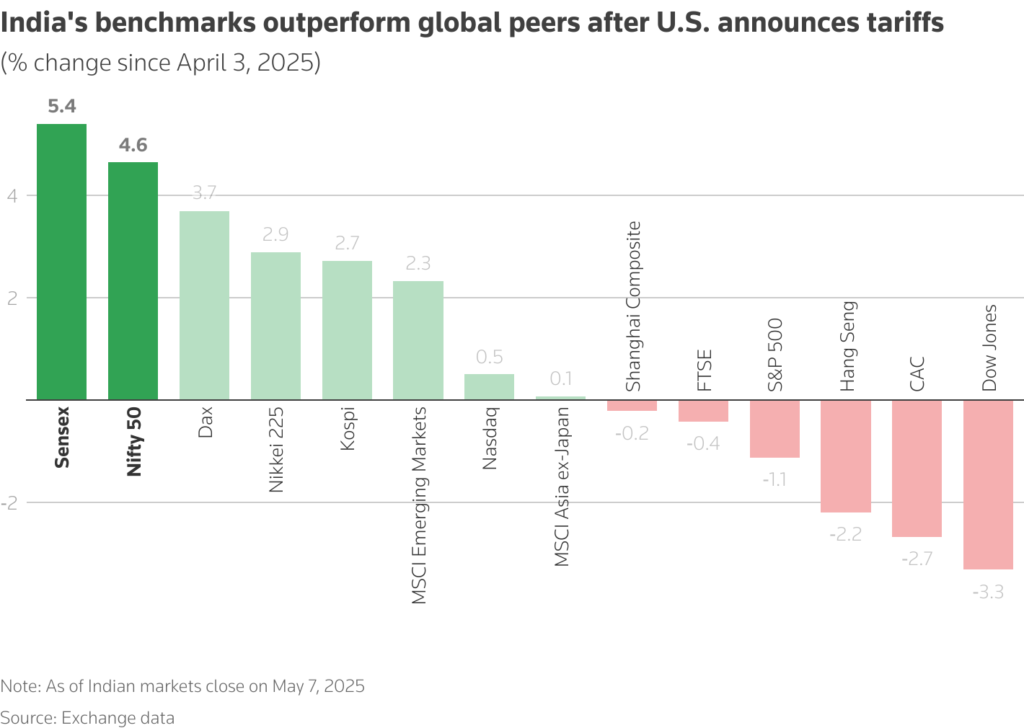
Since early April, when the United States announced reciprocal tariffs on its trading partners under President Donald Trump’s administration, India’s benchmark Nifty 50 index has risen by 4.6%, outperforming many other major global markets.
“The Indian market had begun to outperform on the back of the perception that there is some insulation from Trump tariffs given the strength of domestic consumption and a clear signal of monetary loosening from the central bank,” explained Sat Dhura, portfolio manager at Janus Henderson Investors.
Foreign Investment Flows: Short-term Caution, Long-term Confidence
Foreign investors, who had been heavy sellers of Indian stocks from October 2023 to March 2024, reversed course in April and early May 2024, purchasing approximately $1.5 billion in equities. However, they continued to divest from Indian bonds, selling $1.7 billion since the beginning of April.
The current geopolitical situation may temporarily dampen foreign portfolio inflows, according to UAE-based asset manager NAV Capital, but global investors are expected to maintain their positions in India unless the conflict significantly escalates.
“While sentiments are likely to be jittery in the immediate term, these tensions are unlikely to derail the medium-term appeal of the Indian economy,” said Radhika Rao, senior economist at DBS Bank in Singapore.
Trade Deals Remain the Focus
The primary focus for India’s economic outlook remains on its international trade agreements rather than the border conflict. India secured a long-negotiated trade deal with the United Kingdom just a day before the military strikes, and discussions are ongoing for a bilateral trade agreement with the United States.
These developments are seen as more consequential for India’s economic future than the current tensions with Pakistan. As part of these trade negotiations, India plans to reduce high tariffs on raw materials that have historically hindered large-scale manufacturing in the country.
“More substantial developments like the just-concluded India-UK trade deal, the impending agreement with the U.S., and the central bank’s dovish policies will dictate the path of India’s growth trade outlook,” Rao noted.
Geographic Insulation of Investment Centers
Former top government bureaucrat Subhash Chandra Garg pointed out that the geographical separation between conflict zones and major investment areas provides another layer of insulation for India’s economy.
“The areas bordering Pakistan are in the north and west of India, but most foreign investment for manufacturing facilities is centered in southern and central India,” Garg explained, suggesting that the impact of the conflict on potential longer-term investment “may not be very much.”
What Investors Are Watching
Financial analysts are closely monitoring several key factors:
- Whether Pakistan’s promised response to India’s strikes leads to further military escalation
- The reaction of major powers like the United States and China in diplomatic efforts to ease tensions
- India’s ability to maintain focus on economic reforms and trade negotiations amid the conflict
- Potential impacts on energy prices, which could affect India’s inflation outlook
For now, domestic investment flows are expected to remain stable, providing crucial support to Indian markets despite potential hesitancy from foreign investors in the short term.
Conclusion
As world leaders call for restraint from both India and Pakistan, India’s economic fundamentals and investment appeal appear largely unshaken by the current military tension. Barring a significant escalation of hostilities, analysts expect India to continue its economic growth trajectory, supported by strong domestic consumption, favorable monetary policy, and expanding international trade relationships.
The real test for investor confidence will likely come in the days ahead as Pakistan determines its response to India’s military action, and the international community works to prevent further escalation between the nuclear-armed neighbors.




Leave a comment